
Exploring gender identity in your 40s with support in Tucson

You don’t need to identify as 2SLGBTQIA+ or have a label to begin exploring gender identity in your 40s in Tucson. You can seek support while you’re still figuring out what feels right, or whether any label fits at all. Your age doesn’t make your questions less valid.
It can feel vulnerable to share thoughts you’ve carried privately, especially when you’re unsure what they mean or how they might affect your relationships. You’re welcome to bring that uncertainty: your experience is your own, and there’s no single path or timeline for understanding yourself.
This article explains how identity differs from gender expression, why labels are optional, and ways to explore these questions at your own pace. It also covers affirming support in Tucson, including working with a therapist who respects your self-understanding and does not use conversion therapy. Take what’s useful and leave the rest as you find a way forward that feels right for you.
Key Takeaways
- You don’t need a 2SLGBTQIA+ label to explore gender or seek affirming support.
- Notice what feels comfortable in your expression without treating it as proof of a particular identity.
- Consider how honest conversations and supportive boundaries might affect your relationships.
- Use identity terms only if they help you describe your experience; your understanding can change over time.
- Individual, family, group, and EMDR therapy can offer different ways to explore questions and relationship concerns with Gender Identity Center.
Do I need to identify as 2SLGBTQIA+ to access these services?
No. You can seek mental health support while questioning, exploring, or choosing not to use an identity label. You might want to discuss how a name, pronouns, clothing, or relationship feels without deciding what it means. In Tucson, Gender Identity Center offers in-person and telehealth therapy to clients located in Arizona, so your location and preferred format can guide where you start.
An affirming therapist respects how you describe yourself and makes room for uncertainty. Look for someone who does not practice conversion therapy and can discuss gender without steering you toward a predetermined outcome. In an initial conversation, notice whether the therapist asks what support would be useful, uses your requested name and pronouns, and welcomes questions about privacy. You can also ask about their experience with gender exploration and their approach to therapy.
Therapists bring different specialties and approaches to conversations about gender. You might want space to understand recurring feelings, or support with anxiety, communication, or self-acceptance. Therapy can focus on your goals without assuming that exploration must lead to a particular identity or decision. For example, you could start by describing when you feel most at ease, then reflect on what those moments mean to you.
Before a consultation, write down one or two priorities, such as exploring expression or discussing a relationship. Ask how sessions are structured, whether they’re in person or by telehealth, and what confidentiality means in your circumstances. A consultation can help you assess whether the therapist listens carefully and explains their approach clearly. Your preferences can guide whether you continue and what you discuss first.
Starting gender-affirming hormone therapy generally involves discussing your goals, health history, possible benefits and risks, and follow-up with a qualified medical clinician. The appropriate steps depend on the treatment and your circumstances. Therapy can help you clarify questions, but it does not replace medical care or provide hormone prescriptions.
For adults in their 40s, potential benefits, risks, and costs depend on the type of care, personal health, provider, and insurance coverage. Mental health support may help you reflect on goals and relationships, while medical care involves its own considerations. The effects and costs are not identical for everyone, so identify which form of care you mean before comparing options.
For Arizona identification documents, first identify which record you want to update, such as a state identification card or another document. Each issuing agency may have its own process and requirements, so follow that agency’s instructions for the specific name or gender-marker change. Separating identity exploration from paperwork can make the process feel more manageable; you can decide whether and when an update feels right.
Supportive environments and freedom of expression
Adults exploring gender identity in their 40s in Tucson can begin through reflection, conversation, and choices about expression. You might notice how different clothing, names, pronouns, or social settings feel without treating any single choice as a final answer. What feels comfortable can vary from person to person and may shift with context.
Support for Transgender and Non-Binary Adults
Support can focus on your goals, whether you identify as transgender, non-binary, questioning, or use no label. You might want to discuss how to be addressed at work, how to share your identity with a friend, or how to handle discomfort in a particular setting. The focus can be understanding your experience, not persuading you toward a specific identity.
For adults exploring gender identity in their 40s in Tucson, it may help to consider whether a therapist listens to your language, respects your choices, and makes room for uncertainty. You could bring a specific situation, such as deciding whether to use a chosen name with family. Explore therapist specialties to see how professional support may relate to your needs.
Tucson LGBTQ+ Support Resources
In Tucson, support may include affirming mental health care and community spaces where you can meet people with varied experiences. Consider what would help: a private conversation with a therapist, a group setting, or language that helps you describe yourself. Your preferred level of privacy can guide which setting feels comfortable.
Before joining a group or sharing personal details, consider what you hope to gain from that space. You might want practical conversation about disclosure, or connection without having to explain every part of your identity. A supportive environment can let you set boundaries, choose what to share, and change your mind as your needs shift.
Exploring Gender Identity Through Expression
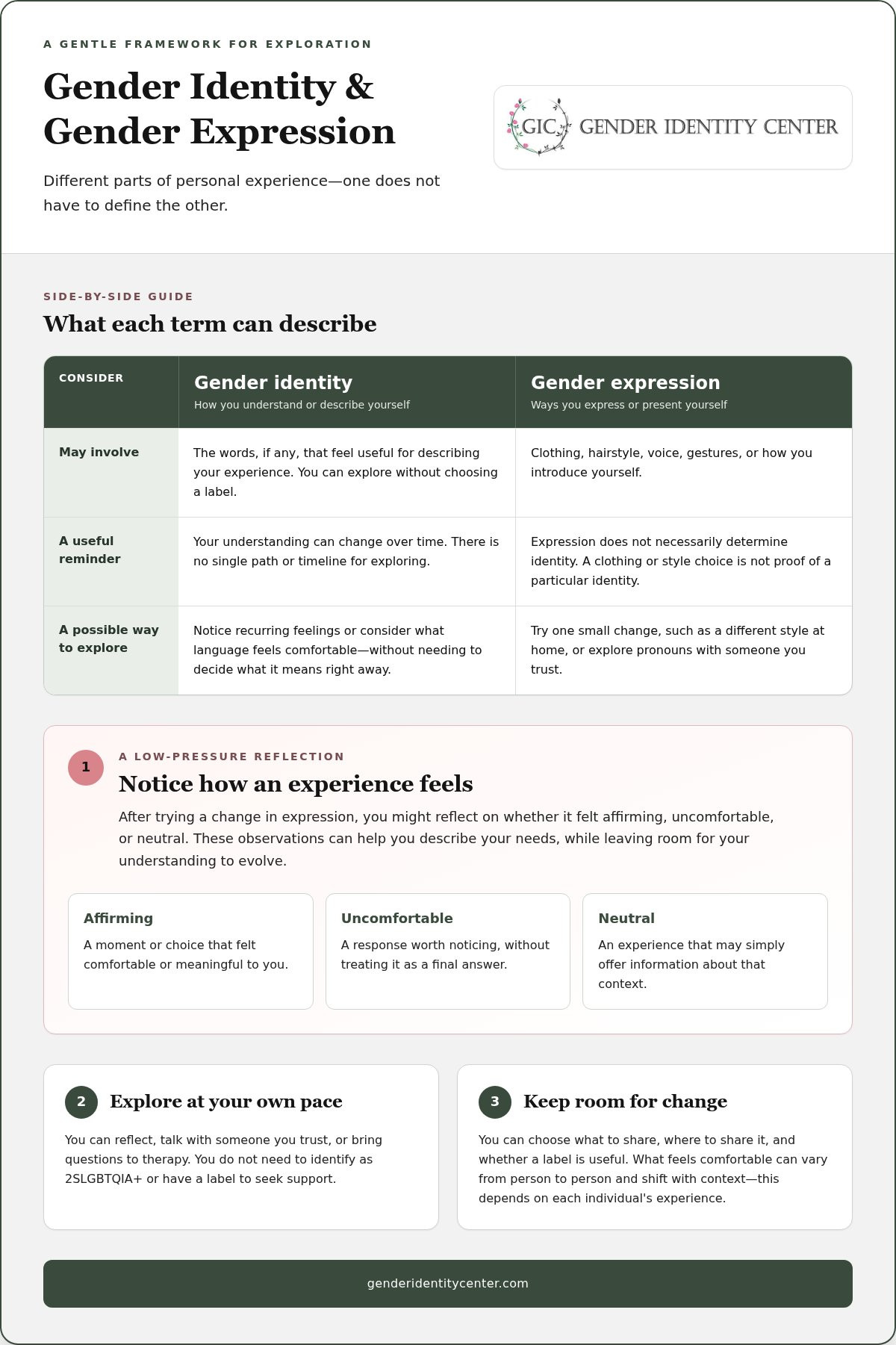
Gender identity and gender expression are different, and one doesn’t necessarily determine the other. Expression can include clothing, hairstyle, voice, gestures, or how you introduce yourself. Trying one small change, such as wearing a different style at home, may help you notice what feels comfortable without requiring a label or public announcement.
As you explore gender identity in your 40s in Tucson, reflect on what felt affirming, uncomfortable, or neutral after trying a change. You could also explore different pronouns with a trusted person before using them elsewhere. These observations may help you describe your needs in therapy or personal conversations, while leaving room for your understanding to evolve.
Family and relationship stress related to identity
Exploring gender can raise new questions in established relationships, including partnerships, friendships, and family roles. You might feel ready to share something with a partner while preferring privacy with relatives. Before a conversation, decide what you want them to understand, what you’re not ready to discuss, and whether you’d like to continue the conversation later.
A specific plan can make a difficult conversation feel clearer. You could say, “I’m exploring how I understand my gender, and I’m not asking you to have every answer today.” Then make one practical request, such as using a chosen name at home or listening without offering immediate advice. This gives the other person something concrete to respond to.
Partners may have their own feelings and questions as a relationship changes. You don’t need to resolve everything in one discussion. Consider setting aside time to talk, choosing one topic, and agreeing to pause if either person feels overwhelmed. For example, you might discuss what to share with friends separately from decisions about clothing or public presentation.
Family conversations can involve questions of privacy and timing. Before sharing with a relative, think about whether you want them to keep the information private, whom they might tell, and what response would help you feel respected. If you’re unsure, practise the conversation with a trusted friend or write down what you want to say. You can share one part of your experience rather than explaining everything at once.
With children or adult relatives, clear, age-appropriate language can reduce confusion. You might explain, “I’m learning more about what feels right for me,” then invite questions without promising immediate answers. Each family member may process the conversation differently. Boundaries can help: answer questions you welcome and decline those that feel too personal.
Notice how relationship stress shows up in everyday moments. You might feel tense before family gatherings, avoid a partner’s questions, or feel more at ease with a particular friend. Naming the situation can help you identify what support or change you want. A community connection may offer companionship, while private reflection may help you decide what to share next.
If conversations become repetitive, agree on a next step rather than trying to settle every disagreement. You might schedule another discussion, write down questions, or ask a supportive person to help keep the conversation respectful. Individual or Family Therapy can also provide space to explore communication patterns and boundaries. The aim can be understanding your needs, not forcing a particular decision about your identity or relationships.
2SLGBTQIA+ terminology and identity labels
Labels can offer language for describing identity, but they don’t have to settle every question. The acronym 2SLGBTQIA+ commonly includes Two-Spirit, lesbian, gay, bisexual, transgender, queer or questioning, intersex, and asexual people, with the plus sign making room for other identities. People may use one term, several terms, or none. The words that feel useful can depend on each person’s experience and may change over time.
The letters can describe different parts of someone’s experience. Gender identity concerns a person’s internal understanding of their gender, while sexual orientation concerns patterns of attraction. A transgender person, for example, may be straight, bisexual, gay, or use another description. These terms aren’t interchangeable, and one label doesn’t automatically explain someone’s relationships, expression, or personal history.
Two-Spirit has a distinct cultural context. The contemporary term was coined at the Third Annual Intertribal Native American, First Nations, Gay and Lesbian American Conference in Winnipeg in 1990. It is used across more than 150 Indigenous nations in North America, with meanings that vary among communities. Two-Spirit is not a general substitute for transgender or non-binary; its meaning is connected to Indigenous identity and culture.
The term LGBTQ developed in the 1990s as an expansion of the earlier LGB formulation. Since then, additional letters and the plus sign have appeared in different versions of the acronym. You may see LGBTQIA+, 2SLGBTQIA+, or other variations in books, community spaces, and therapy settings. These differences don’t necessarily mean that one person’s identity is more valid than another’s.
To explore terminology without pressure, try a small, practical exercise:
- Write down words you’ve encountered, such as non-binary, queer, or questioning.
- Notice which descriptions feel comfortable, unfamiliar, or simply not relevant.
- Consider whether a term helps you communicate with a trusted person.
- Leave a word aside if it feels limiting or doesn’t fit your experience.
You might use “questioning” privately while deciding whether to share it with a friend. Another person might prefer no label but still want language for a particular feeling. A term can be a useful signpost on your journey, not a permanent commitment. You’re also free to clarify what a word means to you, since people may understand the same label differently.
If a label brings relief, curiosity, or discomfort, those reactions can be useful to reflect on. Ask what the word makes easier to express and what it leaves out. There’s no vocabulary test to pass before seeking support; start with the language that best represents your experience right now.
Binary bias and fluid understanding
A binary view treats gender as only two fixed categories: man or woman. You may encounter this assumption on a form with two options or in a conversation that presumes everyone fits one category. Those moments can leave little room for people whose identity feels outside, between, or broader than those choices.
Notice where a binary assumption shapes your decisions. You might feel pressure to choose a label before you know what feels accurate, or to change your appearance to meet others’ expectations. Naming that pressure can help separate your preferences from rules you’ve absorbed. Everyone’s experience is different, and you can decide which expectations deserve your attention.
Some people describe their gender as fluid because their sense of identity shifts over time or in different circumstances. Others experience their identity as steady, even if their expression changes. Neither pattern needs to serve as a test or comparison. Consider what feels true now, then let your description develop without treating change as a contradiction.
Track specific situations rather than searching for one final explanation. After a family gathering, workday, or time alone, note what felt comfortable and what felt constrained. You might notice that a particular name feels right with one trusted person, while another setting brings different feelings. These observations can guide reflection without requiring an immediate announcement or decision.
Binary bias can shape how people interpret clothing, voice, or interests. Someone may assume a person’s gender from their hairstyle, then use that assumption to decide which pronouns to use. You can correct the assumption, offer a brief clarification, or choose not to engage in that moment. Your response may depend on your safety, energy, and relationship with the person.
If you’re unsure how to describe your experience, start with language that feels provisional. Phrases such as “I’m exploring,” “I’m not sure yet,” or “I use this term for now” leave room for learning. You can also keep private notes about words that feel comfortable, uncomfortable, or incomplete. A label can be useful without explaining every part of your life.
In a therapy conversation, you might bring one example of binary pressure and explore its impact on your choices. A therapist’s gender-related approach can provide a setting to examine assumptions, identity, and expression at your own pace. You remain the person who decides which descriptions fit and whether they continue to fit.
Gender Identity Center: Individual Therapy
Gender Identity Center offers Individual Therapy to explore identity, expression, and the questions that matter to you. Sessions give you space to reflect on what feels affirming, consider relationship concerns, and clarify your goals without needing to arrive with a label or fixed plan.
If you’d like to involve loved ones, Family Therapy can make room for shared conversation. Group Therapy offers another setting for connection, while EMDR Therapy may be relevant when working through difficult experiences. The right focus depends on what you want to explore and what feels useful to you.
If individual support feels like a helpful next step, schedule with Gender Identity Center at a pace that feels comfortable.
Take the next step at your own pace
Your next step doesn’t need to define your whole future. You might start by naming one question you want to explore, such as how you want others to address you or what feels comfortable in a relationship. Bringing that question to a supportive conversation can help you focus on what matters now while leaving room for your understanding to change.
Exploring gender identity in your 40s in Tucson can be a personal process, not a decision you need to explain to everyone at once. If you want loved ones involved, Family Therapy can offer space for shared conversations; Group Therapy may provide a setting for connection with others. Which feels useful depends on your circumstances and preferences.
When you’re ready to consider support, contact Gender Identity Center and share what you’re hoping to explore. You can begin with the question you have today. Let your next step be small, intentional, and yours.
Frequently Asked Questions
How soon can I meet with a therapist?
The time until a first session depends on appointment openings. Use the scheduling page to request a meeting and share any timing constraints or preferences. You can describe the concerns you want to discuss, even if you’re still unsure how to name your experience. This gives you a practical starting point without requiring you to arrive with a settled identity or a complete explanation.
What Is Affirming Therapy for 2SLGBTQIA+ Folx?
Affirming therapy makes space for your identity and goals without requiring you to prove yourself or settle on a label. You could focus on navigating a workplace conversation, processing a relative’s response, or deciding what name feels comfortable in a particular setting. The therapist’s role is to support your reflection and mental health, not direct you toward a predetermined identity or transition choice.
What should I consider when choosing a therapist?
Consider whether the therapist’s experience and communication style fit the concerns you want to discuss. You might prioritize support with identity questions, relationship stress, or difficult past experiences. Notice whether you feel heard and whether the therapist explains their approach clearly. Confidentiality may also matter: Gender Identity Center keeps client information private and does not disclose it without both verbal and written or signed permission.
What gender-affirming therapists in Tucson work with adults questioning their gender?
Gender Identity Center offers Individual Therapy and gender-focused counseling for people exploring gender. Information about its therapists can help you learn about clinicians and consider whom you may want to work with. You can describe your current questions without choosing a label first. To prepare for a first conversation, note the topics you hope to address, such as identity, expression, or talking with someone close to you.
What Tucson support groups serve adults exploring gender identity?
Gender Identity Center’s Group Therapy may offer a structured setting for sharing and listening with others. Groups meet once per week for 8 to 10 weeks and typically include 6 to 8 clients in the same age range. Consider whether you’d prefer a group conversation or individual space, and what you hope to gain from participating. You can start by identifying topics you feel comfortable discussing in a group.