
Coping with Surgery Delays or Cancellations in Phoenix: Finding Support While You Wait

What if a changed surgery date unsettles more than your calendar? You may be holding disappointment, grief, worry about work or family plans, or simply wanting clearer information. There isn’t one right response. Coping with surgery delays or cancellations in Phoenix depends on each individual’s circumstances and what the change means to them.
If you’re feeling frustrated, anxious, or unsure what comes next, those reactions are understandable. A delay doesn’t define how you should feel, and you don’t have to make sense of everything at once. This article offers practical ways to care for your emotional wellbeing, prepare questions for your surgical care team, and consider affirming support while plans shift.
The Gender Identity Center offers individual therapy in Phoenix and Tucson, as well as telehealth for clients located in Arizona. Therapy can provide space to explore the emotional impact of a changing timeline, but it does not provide surgical scheduling or medical advice. Client information is kept private and is not disclosed without both verbal and written or signed permission. You can decide what support feels useful and move at your own pace.
Key Takeaways
- Your response to a changed surgery date may be mixed or shift over time. There’s no single way you’re expected to feel.
- Ask your surgical care team what is known, what remains uncertain, and when you might receive another update.
- For coping with surgery delays or cancellations phoenix, make a flexible plan around your immediate needs, then adjust it as circumstances change.
- Emotional support can help you explore what the waiting period brings up without deciding your surgical timeline or medical care for you.
- Individual therapy can offer space to consider what support feels useful to you, at a pace that fits your experience.
Coping with Surgery Delays or Cancellations in Phoenix Starts with Making Room for Your Reaction
A postponed or canceled procedure can bring different feelings for different people. You might feel disappointed after preparing for a date, relieved to have more time, angry about plans changing, or numb while you take in the news. Several feelings can coexist, and your response may shift from day to day. None of these reactions has to be the “right” one.
Surgery isn’t a required milestone, and a procedure’s place in your life or gender journey is yours to define. A changed timeline does not determine the meaning of your care journey. If you’re coping with surgery delays or cancellations in Phoenix, your experience will depend on your hopes, circumstances, and what the change means to you.
Why a change in plans can feel emotionally complicated
Anticipating surgery can involve more than marking a date on a calendar. You may have arranged time away from work, organized help at home, prepared emotionally, or shared plans with people close to you. When the date changes, those preparations can feel uncertain. You may also have questions about what happens next, or need time to absorb the news before deciding what it means to you.
Your circumstances matter. Work, caregiving, finances, relationships, privacy, and personal hopes may all shape how a postponement lands. These factors vary from person to person, so there is no universal emotional response or timeline for coping. You don’t need to feel hopeful, make peace with the change, or explain your reaction on anyone else’s schedule.
Let your own meaning guide what support feels right
Instead of judging your feelings, try naming what feels hardest right now. Is it the uncertainty, adjusting plans, feeling misunderstood, or something else? You might not have a clear answer yet. Noticing what’s coming up can help you consider what kind of support would be useful, without requiring you to solve everything at once.
Your immediate needs may be different from someone else’s. You might want practical information, reassurance from someone you trust, or quiet before talking about it. Consider asking yourself:
- Would it help to talk, or would I prefer some space for now?
- Am I looking for reassurance, clearer information, or help with practical plans?
- Who feels safe to tell, and what am I comfortable sharing?
You get to choose whether to share the change, whom to tell, and how much detail to offer. If someone responds in a way that doesn’t fit your experience, you can set a boundary or wait to discuss it with someone who feels more affirming. Your next step can be small, and it can change as your needs become clearer.
Understand What You Can Clarify with Your Surgical Care Team
After plans change, clear information may help you decide what to do next. The reason for a delay and what it means for your care are specific to your situation, so try not to fill gaps with guesses. Your surgeon or surgical care team is the source for questions about your procedure, its status, and clinical decisions.
Emotional support and clinical guidance serve different purposes. Emotional support can help you make space for your feelings; decisions about surgery belong with you and your surgical care team. If you’re coping with surgery delays or cancellations phoenix, a focused conversation may help you separate what’s known from what is still unfolding.
Questions that may help make the next conversation clearer
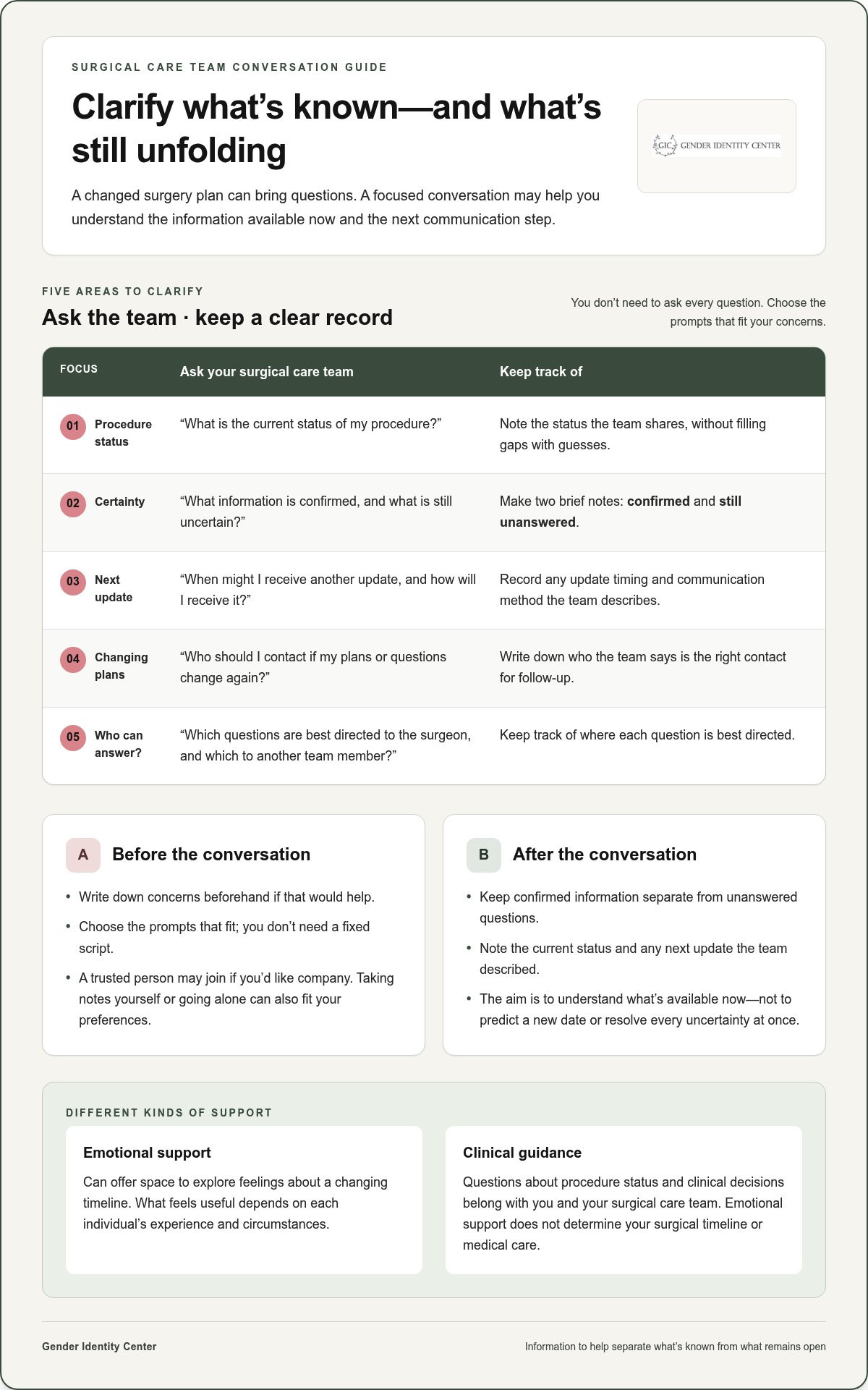
You don’t need to ask every question or follow a fixed script. Choose the prompts that fit your concerns, and add your own if something important is missing:
- What is the current status of my procedure?
- What information is confirmed, and what is still uncertain?
- When might I receive another update, and how will I receive it?
- Who should I contact if my plans or questions change again?
- Which questions are best directed to the surgeon, and which to another member of the care team?
If you’re unsure how to raise a concern, write it down beforehand or ask the team which person is best placed to respond. The goal isn’t to predict a new date or resolve every uncertainty in one conversation. It’s to understand the information available now and the next communication step.
Separate confirmed information from unanswered questions
After speaking with the team, consider making two brief notes: what they confirmed and what remains unanswered. You could record the current status, any next update they described, and a question you still want to ask. Keeping these separate may make it easier to revisit the conversation without treating an unknown as a settled fact.
You can also bring a trusted support person if you’d like company. They might help you remember what was said or simply be present. This depends on your preferences and circumstances. Going alone, taking notes yourself, or asking someone to join can all be reasonable options.
If anxiety is part of the waiting, Memorial Sloan Kettering Cancer Center offers strategies for managing pre-surgery anxiety. You might consider these ideas alongside guidance from your own surgical team. The resource cannot answer questions about your procedure or timing.
For space to explore the emotional side of a changing timeline, individual therapy may be one option. The Gender Identity Center offers therapy in Phoenix and Tucson, and telehealth for clients located in Arizona. Client information is not disclosed without both verbal and written or signed permission. You can explore scheduling individual therapy if this kind of support feels relevant.
Create a Flexible Plan for the Waiting Period in Phoenix
A changed date can leave you unsure what to organize first. A flexible plan can offer some structure without asking you to predict what will happen or stay busy every moment. Think of it as a set of options, not a checklist you have to complete. What feels manageable depends on each individual’s experience and circumstances.
You might take these steps in an order that suits you, pause, or skip any that don’t fit:
- Notice what you need today. That might be quiet, time to talk, practical help with plans, or a chance to sit with your feelings.
- Use the information you have. Keep track of what your surgical team has confirmed and what is still uncertain. Don’t treat unanswered questions as settled plans.
- Choose one manageable support. You could reach out to someone you trust, review an affected commitment, or leave plans open until you have more information.
This is about tending to your current needs, not medical preparation. Questions about procedure-specific preparation, timing, or changes to your care belong with your surgical team. You don’t have to turn uncertainty into a productivity project, and positivity or distraction doesn’t need to be your goal.
Protect space for the feelings you are having now
If it feels useful, take a few minutes to write down what’s on your mind or talk with someone you trust. You might prefer privacy instead, or feel supported by community. There’s no single approach that suits everyone, and trying one option doesn’t mean you have to keep using it. Notice what feels manageable today, then give yourself permission to change course.
Adjust everyday plans without treating uncertainty as failure
Reviewing your calendar can help you see which arrangements are affected, but you can do this at your own pace. Some commitments may be easy to keep flexible; others may depend on information you don’t have yet. Rather than deciding everything now, make a short note of what needs attention and what can wait.
For example, if you arranged time away from work or asked someone to help with a practical task, consider what can be changed and what information you need before making a new plan. The specifics depend on your circumstances. Revising arrangements is a practical response to changing information, not evidence that you planned poorly.
As you consider coping with surgery delays or cancellations phoenix, let the plan serve you. It can be as small as identifying one immediate need and one next step. If your capacity changes, your plan can change too. You’re allowed to move at a pace that feels workable, even if the timeline around you remains uncertain.
Find Affirming Emotional Support in Phoenix Without Losing Your Autonomy
Support can be useful without taking control of your decisions. A therapist can offer space to explore what a changing surgery timeline brings up, but therapy is separate from surgical care, medical advice, and decisions about procedure timing. Those clinical questions remain with you and your surgical care team. You can decide what kind of emotional support, if any, feels right for you.
For some people, coping with surgery delays or cancellations phoenix may include talking with a therapist who understands the importance of being seen and respected. For others, support might come from trusted people in their lives or from having time alone. This depends on each individual’s experience. There is no single support choice that everyone needs to make.
What affirming therapy can offer while plans are changing
Individual therapy may give you a collaborative space to reflect on stress, identity, relationships, or the meaning you attach to the change. You remain the expert on your own experience. You can set the focus, name what you want to explore, and adjust those goals as your needs evolve. A therapist can listen and support reflection without deciding what your gender journey should look like.
Therapy doesn’t determine surgical eligibility, set a procedure date, or provide medical direction. It also can’t promise a particular emotional outcome. Sessions may offer room to notice what’s weighing on you and consider what kind of support feels affirming. You might explore how to talk with loved ones, or make room for complicated feelings without needing to settle them immediately.
If you’re considering a therapist who understands gender-affirming experiences, the Gender Identity Center’s therapists page offers a way to learn about clinicians. You can consider what matters to you in a therapeutic relationship, such as feeling listened to, having your identity acknowledged, or being able to set the pace of conversations.
Choose the format and people that feel comfortable to you
The Gender Identity Center provides in-person therapy in Phoenix and Tucson, as well as telehealth for clients located in Arizona. For a telehealth session, you need to be physically located in Arizona. Meeting in person or by video may feel more accessible or comfortable depending on your circumstances. Consider what works for your privacy, schedule, and sense of ease, without treating either format as the right choice for everyone.
It’s also okay to take time before deciding whether therapy fits what you need right now. You might think about what you hope to discuss or whether you’d feel more comfortable beginning with a specific concern. If you’d like to explore an initial step, you can look at scheduling options for therapy. The choice to seek support, and what you hope to bring into that space, remains yours.
Take a Gentle Next Step with Gender Identity Center Support
The Gender Identity Center provides mental-health therapy, not surgery or other medical procedures. Individual therapy may offer room to explore what a changing timeline brings up and what kind of support feels useful to you. It doesn’t determine procedure timing or change decisions made with your surgical care team. The focus can stay on your experience, needs, and goals.
There’s no requirement to arrive with a clear explanation or a specific outcome in mind. You might want to talk about uncertainty, the effect on relationships or plans, or how you’d like others to support you. You can also begin by saying you’re not sure where to start. What feels relevant depends on each individual’s experience, and your focus can shift over time.
What to expect from a first conversation about support
A first conversation can be a place to share what feels comfortable and relevant to your goals. You might choose to discuss the surgery delay or focus on another part of your life. You can decide what you’re ready to talk about and what you’d rather leave aside for now. Standard therapy sessions are 50 minutes. That time doesn’t guarantee a particular result or emotional response; it offers space for conversation and reflection.
If it helps, think beforehand about one thing you’d like a therapist to understand or one question you have about therapy. You don’t need to prepare a complete account of your experience. Starting with a small concern, or taking time to find words, can be part of the conversation too.
Decide whether support feels useful right now
Some people may want support while plans are changing; others may prefer to wait or lean on people they already trust. Either choice can make sense. The timing and form of support depend on each individual’s circumstances, comfort, and readiness. You’re not behind if you don’t seek therapy now, and you don’t have to wait until you feel overwhelmed to consider it.
If you’re in Phoenix or Tucson, in-person therapy may be an option. Telehealth is available to clients located in Arizona. You can consider which format feels more comfortable, including what works for your privacy and day-to-day needs. Therapy can support emotional reflection, while questions about medical care and surgery timing remain with your surgical team.
For some readers, coping with surgery delays or cancellations phoenix may include exploring an affirming space to talk. You can review Phoenix therapy scheduling options at your own pace. Looking at the options doesn’t commit you to a particular path. You’re welcome to consider whether individual therapy feels useful now, later, or not at this point in your journey.
Make Room for Your Next Step, Whatever It Looks Like
A changing timeline can make the future feel harder to picture. You don’t have to map the whole road ahead today. You might choose one small point of steadiness, such as deciding what you want to focus on this week or giving yourself permission to revisit plans when you know more. Your next step can be practical, emotional, or simply a pause.
Coping with surgery delays or cancellations phoenix looks different for each person. Your feelings and support needs may shift, and you can respond in ways that fit your life rather than someone else’s expectations. There’s no single pace you need to follow, and seeking support doesn’t require you to have everything figured out.
If you’d like a space to explore what feels useful for you, explore affirming support at the Gender Identity Center. You can take your time deciding whether therapy feels right now, later, or not at all. Your experience is yours to define, one step at a time.
Frequently Asked Questions
Is it normal to feel upset after gender-affirming surgery is postponed?
Feeling upset can be an understandable response, though people react differently. You might notice sadness, irritation, worry about how others will respond, or no strong feeling right away. If people around you expect you to react in a certain way, their expectations don’t define your experience. You’re allowed to decide what the change means to you, without treating surgery as a measure of your identity.
What should I ask my surgical care team after a surgery delay?
You might ask what information is confirmed, how the team will share updates, and whom to contact if you have a question later. If an explanation includes unfamiliar terms, ask for them to be explained in a way that makes sense to you. You could also note when you spoke and what follow-up was discussed, so you have a record to refer to if plans change again.
Can therapy help me cope with a surgery cancellation?
Individual therapy may offer a place to talk through the personal impact of a cancellation, including stress, relationships, or how you want others to support you. It’s emotional support, not surgical care or medical advice, and it can’t change procedure timing or promise a particular result. Whether therapy feels useful depends on your needs and preferences. You can choose a focus for sessions or take time to decide if you want to begin.
What can I do while waiting for a new surgery date?
While coping with surgery delays or cancellations in Phoenix, you might set a reminder to revisit logistics when you receive an update, rather than checking constantly. If the waiting feels consuming, consider choosing one person you can update when you want company or practical help. You could also keep an activity or routine that matters to you, without expecting it to erase difficult feelings. Direct procedure-specific questions to your surgical team.
Can I access telehealth therapy from Phoenix or elsewhere in Arizona?
Yes. Telehealth therapy is available to clients located in Arizona, including people in Phoenix and Tucson. You need to be located in Arizona for the session. The Gender Identity Center also offers in-person therapy in Phoenix and Tucson, so you can consider which format fits your circumstances. Telehealth sessions use a confidential video platform. Your preferred format may depend on privacy, access, and what feels comfortable to you.
How does the Gender Identity Center protect my privacy in therapy?
Client information is kept private and won’t be disclosed without both verbal and written or signed permission. If you have questions about what information you may want to share in therapy, raise them as part of your conversation with the clinician. You can also discuss what feels comfortable to talk about and what you’d prefer to keep private. Feeling at ease with the conversation can look different for each person.
Does the Gender Identity Center perform surgery or provide medical advice?
No. The Gender Identity Center provides mental-health therapy and does not perform surgery or provide medical advice, diagnosis, or prescriptions. Its clinicians can offer emotional support as you reflect on your experience, but questions about a procedure, its timing, or medical decisions belong with your surgical care team. Keeping those roles distinct can help you seek emotional support while receiving clinical information from the people involved in your surgical care.